Prolonged Two Hop F Region Side Scatter
Title: Prolonged Two Hop F Region Sidescatter
Contributed by: Bob Mattaliano N6RFM with Gwyn Griffiths G3ZIL
Reviewed by:
Receiving Station Location: EM12kw, near Fort Worth, TX 4 March 2026
Receiving Station Details: Grape-1 DRF
Feature Description
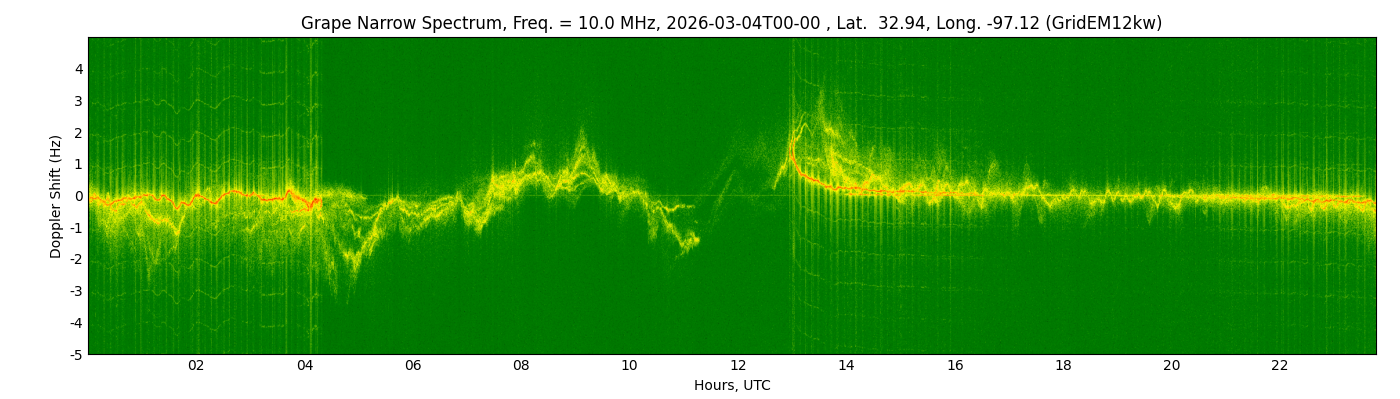
The “Typical Spectrogram” shown elsewhere illustrates the band closing and then opening. This example shows that even when the band is “closed”, weak propagatgion can persist. In this case, two-hop F region sidescatter predominates from ~0415Z onward. This mode continues even until after the band re-opens. Since the Doppler shift through the local night is not near zero, it is unlikely to E region propagation.
3D PyLap ray trace modeling can be used to show the likely geographical regions from which two hop sidescatter between a pair of stations could occur. In this case, the maps below show six frames from an animation covering 0300 UTC to 1730 UTC. In these frames the intensity of the red contours relate to likelihood of sidescatter. However, factors such as weather from the sea or land also affect the strength of the sidescatter. At 0400 UTC (top left), the most likely region (green dot was near the Sea of Cortez. In addition, sidescatter was likely from the Great Lakes region, and also from the Gulf of Mexico. The quite distinct two-way paths to these three regions mean that different Doppler shift could be expected. Hence the multiple traces in this spectrogram. By 1100 UTC, the simple model of sidescatter was likely weak and from the east, strengthening, still predominantly from the east, at 1200 UTC. At 1400 UTC, with the band open for great circle propagation sidescatter would still be expected from the north east and south west.